1. Introduction
Cardiac and
respiratory diseases such as
coronary heart disease,
heart valve disease,
chronic obstructive pulmonary disease (COPD), and asthma cause heavy societal and economic burdens [
[1],
[2],
[3],
[4],
[5]]. These diseases are often first detected by physicians using a stethoscope upon patient complaints. The traditional stethoscope usually consists of a hollow tube attached to a chest piece made from a wider-based diaphragm coupled cavity and a smaller hollow, open bell. Heart and lung sounds vibrate the diaphragm in contact with the patient's chest wall and transmit as sound waves through the cavity and up the hollow tube towards the earpiece. Although most physicians are trained to accurately
diagnose diseases related to the cardiovascular and respiratory systems through a single
auscultation event, there exist chances of
misdiagnosis or underdiagnosis due to potential limitations such as the
absence of symptoms during an examination or even
presbycusis of the physician. Therefore, this has called for the advent of digital stethoscopes, which allow the recording of subtle anomalies present in heart and lung sounds [
6]. The recording can be used for in-depth analysis among physicians and researchers to advance optimal intervention strategies for difficult patient conditions. Other advantages of the digital stethoscope include the ability to amplify the chest sound for optimal listening, the potential to be integrated with computerized algorithms for automated
anomaly detection, and the potential to be used as a
remote monitoring device for better patient management [
6,
7].
Hand-held
auscultation using a digital stethoscope such as the commonly used 3M™ Littmann®
Electronic Stethoscopes Model 3200 is susceptible to motion artifacts due to the device's
rigidity and weight and/or the accidental rubbing or jittery hands of users throughout recordings [
8]. For this reason, there has been an increasing demand for the design of lighter portable,
wearable digital stethoscopes in recent years [
[8],
[9],
[10],
[11]]. With that, motion artifacts can also be reduced, especially with a wearable stethoscope. However, to ensure the reliability of digital stethoscopes in diagnostic care, the acoustic functionality of these newer configurations of stethoscopes must be assessed. For example, the device must have an acceptable acoustic sensitivity to normal and abnormal heart and lung sounds. That led to the design and development of a standardized testing platform for the acoustic characterization of digital stethoscopes [
12]. Moreover, previous works have established the importance of having a standard sound source (preferably an auscultation recording over a white
noise generator at different frequency levels) and a standard objective performance metric to evaluate the acoustic caliber of the digital stethoscopes [
13].
The selections of these stethoscopes for comparison are based on pragmatic criteria. This study aims to objectively qualify the performance of different stethoscopes by cross-comparison with each other. This is alike
medical device validation, where a gold standard is usually used as the reference. However, as digital stethoscopes are not binary
diagnostic devices but diagnostic tools, a gold standard does not exist. Therefore, we cross-compare the performance of different devices and the most clinically used model. The devices are also chosen to represent the different configurations available for digital stethoscopes. Evaluation of digital stethoscopes of different configurations meant for different use environments and use cases is important for the move towards distributed healthcare where digital stethoscopes are not only to be used by trained professionals but also patients themselves for home healthcare and
telehealth.
The pragmatic criteria are as follows:
- •
All the stethoscopes must have at least one regulatory clearance.
- •
Digitalized
bioacoustics recorded must be extractable for performance evaluation.
- •
Sampling frequency of the stethoscope must be at least 4 kHz.
- •
All stethoscopes are of different configurations.
In this study, we compared the acoustic characteristics of four digital stethoscopes with different dimensions and configurations: (a) A miniature wearable digital stethoscope – Device 1, (b) A hybrid digital stethoscope with a dual-head chest piece and a tube connecting a binaural earpiece – Device 2, (c) A digital stethoscope with a single-head chest piece and a tube connecting a binaural earpiece – Device 3, and (d) A wearable digital stethoscope - Device 4. All selected stethoscopes have at least one regulatory clearance as a medical device. The main aim of the stethoscope comparison study is to provide insights into digital stethoscopes' suitability for generalized clinical applications based on their sensitivity in particular frequency ranges. Concretely, the study utilizes a standard benchtop testing platform [
12] and objective metrics developed from a previous study [
13] to ensure that only high-fidelity signals of interest among all the time synchronized recordings obtained from the devices were adopted in the present study. Furthermore, the relative
correlation coefficients in the
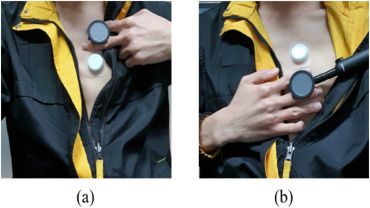
frequency response curves between stethoscopes’ recordings were also computed. Lastly, one of the two wearable digital stethoscopes that showed the higher average relative correlation coefficient and one hand-held digital stethoscope were evaluated on the human chest.
4. Conclusion
Chest auscultation is the most basic diagnostic method used in hospitals and clinics. Physicians are trained to diagnose cardiac and respiratory anomalies using the acoustic stethoscope. However, in some subtle cases, the use of acoustic stethoscopes, compared to electronic stethoscopes, is limited to amplification, frequency band selection, further evaluation, and discussion with other, more experienced physicians to advance the understanding of different pathologies. For new digital stethoscopes to be more widely adopted by physicians, the acoustic characteristics should be similar to the commonly used digital stethoscopes. Hence, this study presented an experimental and analytical framework to evaluate such properties and does so on some emerging electronic stethoscope variants in the market.
Author contribution
Yi Yang Ang: Conceptualization, Investigation, Validation, Formal analysis, Writing – review & editing. Liren Aw: Investigation, Writing – original draft, Formal analysis. Vivian Koh: Investigation, Writing – original draft, Formal analysis. Rex Tan: Conceptualization, Methodology, Validation, Formal analysis, Writing – review & editing, Supervision.